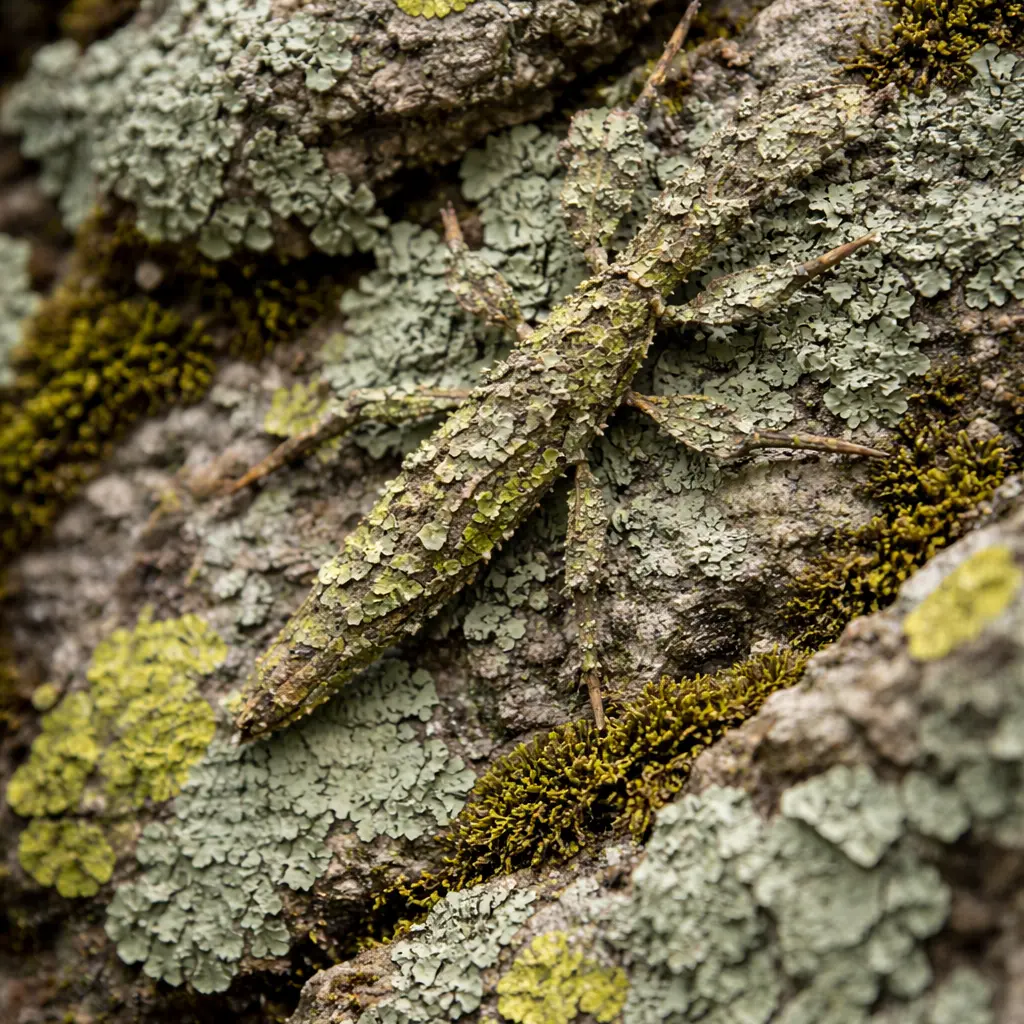
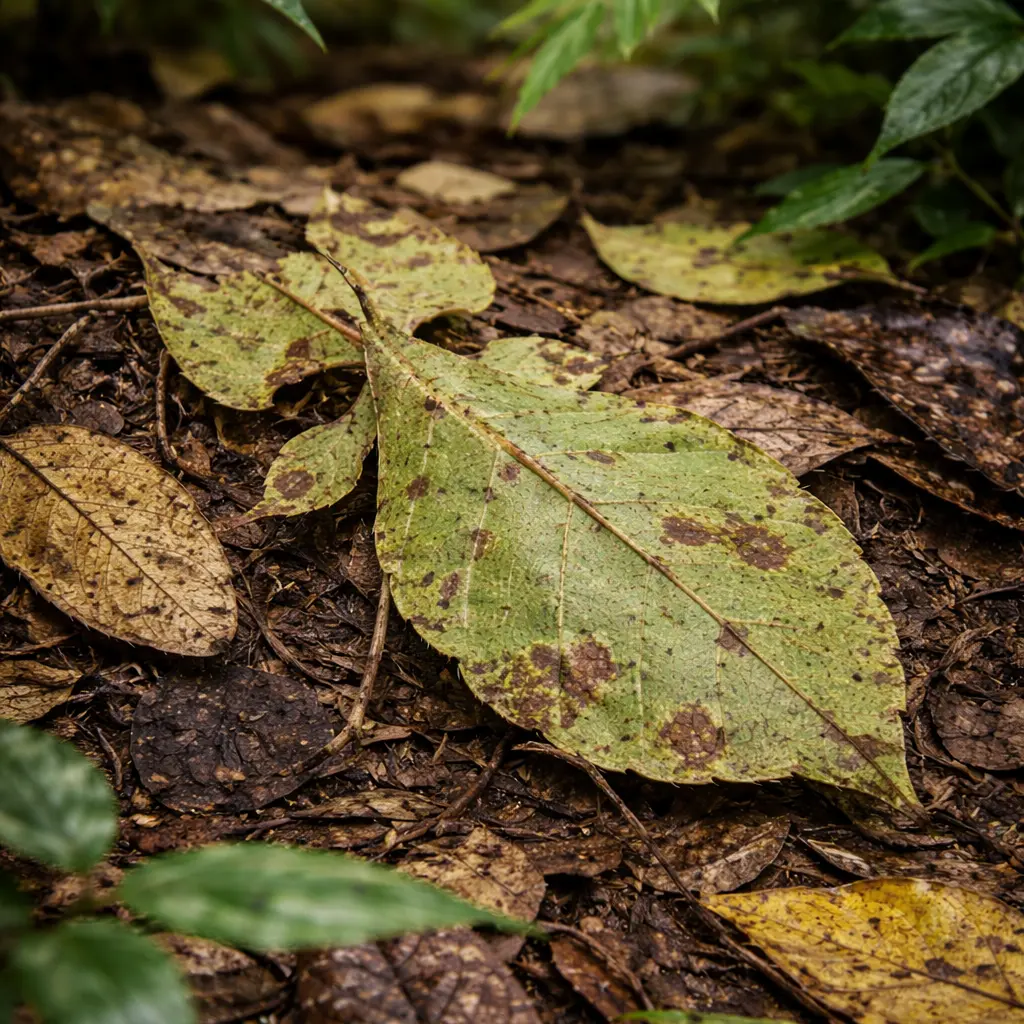
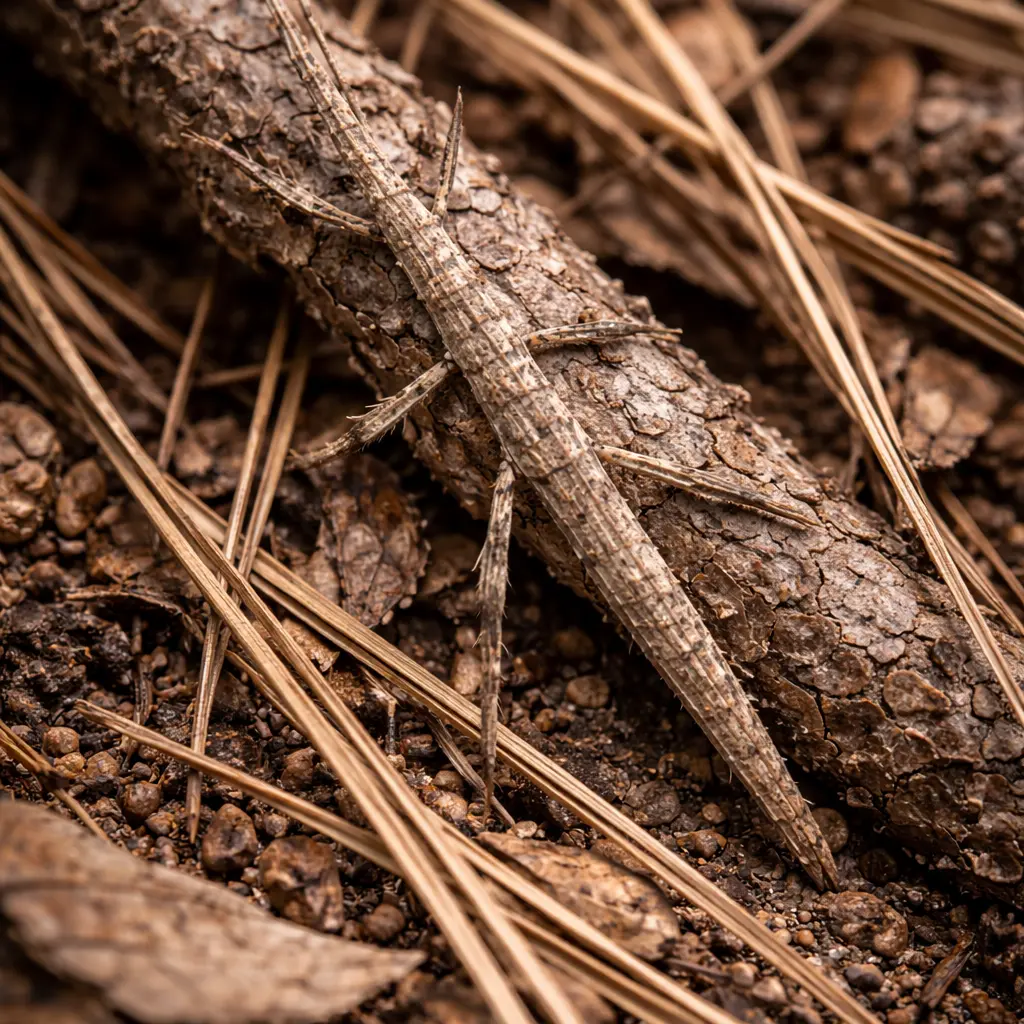
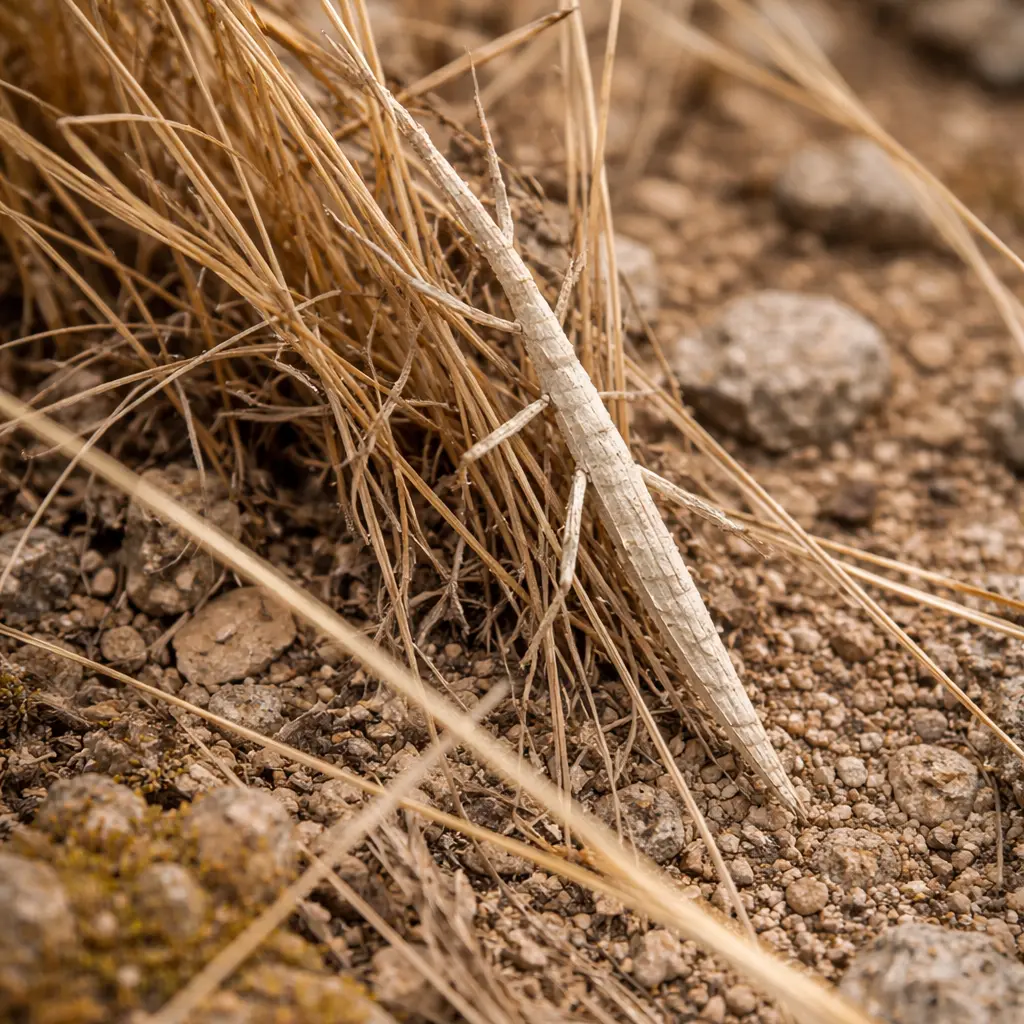
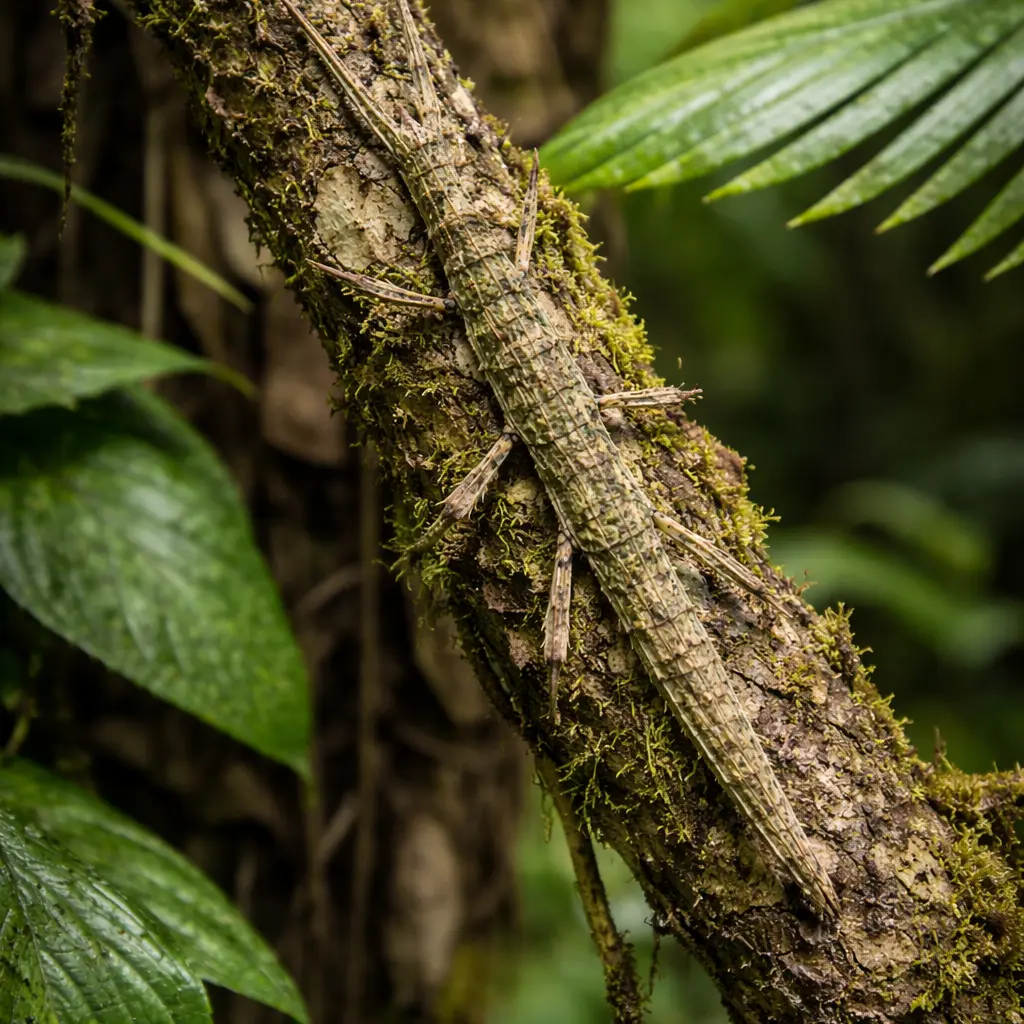

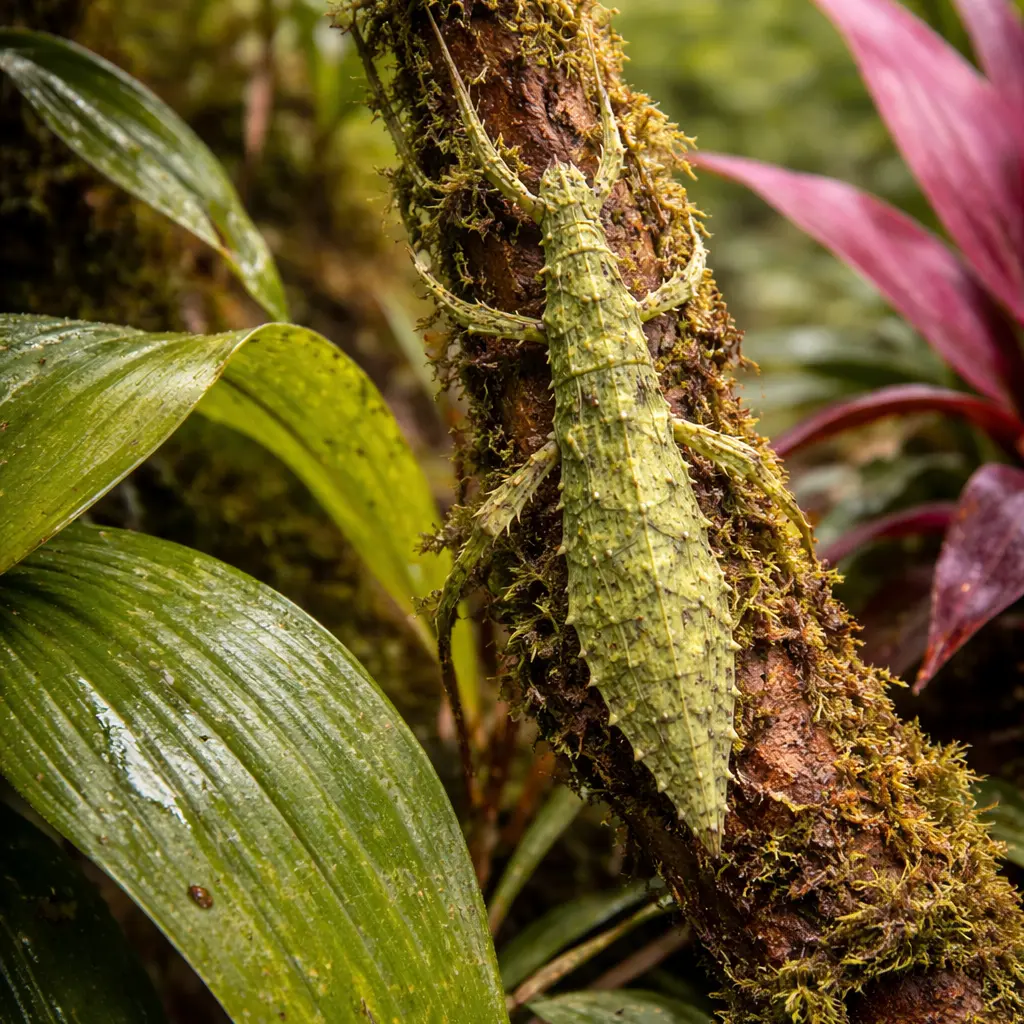
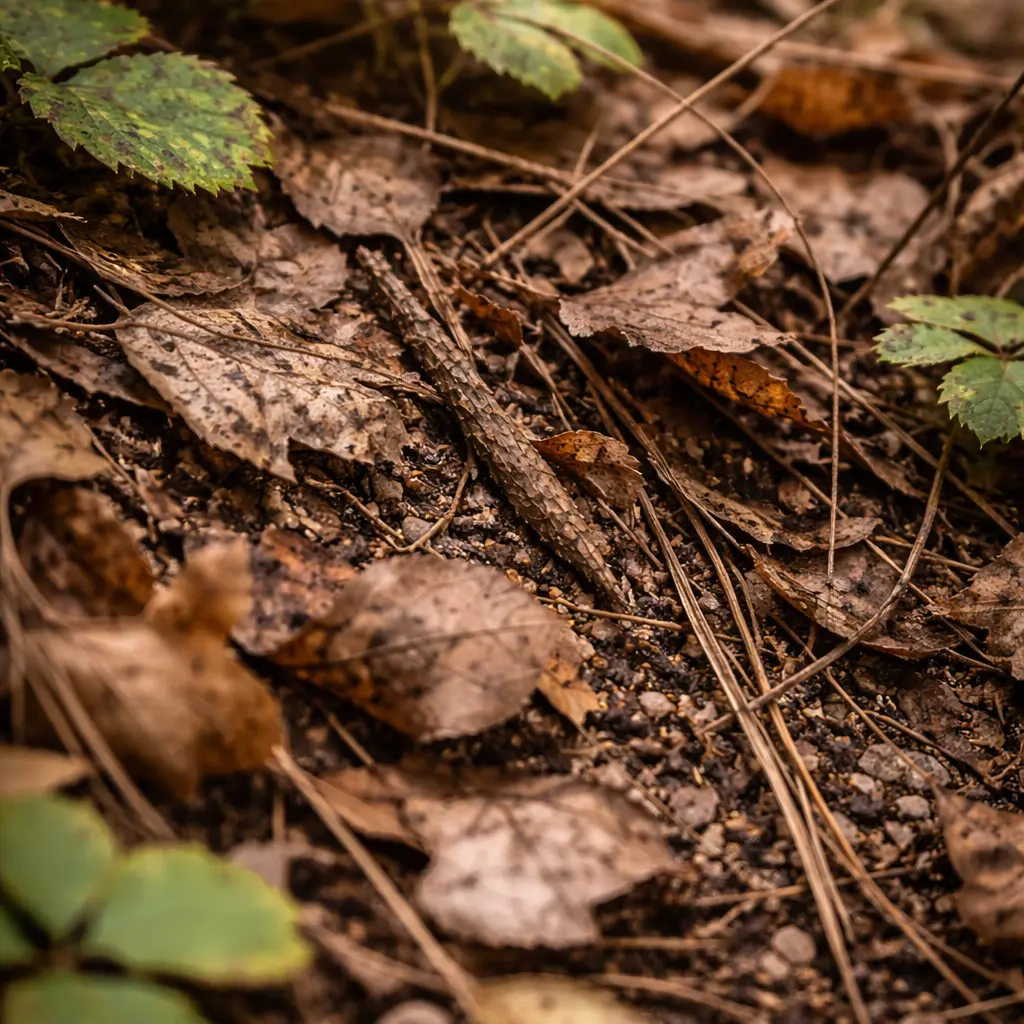

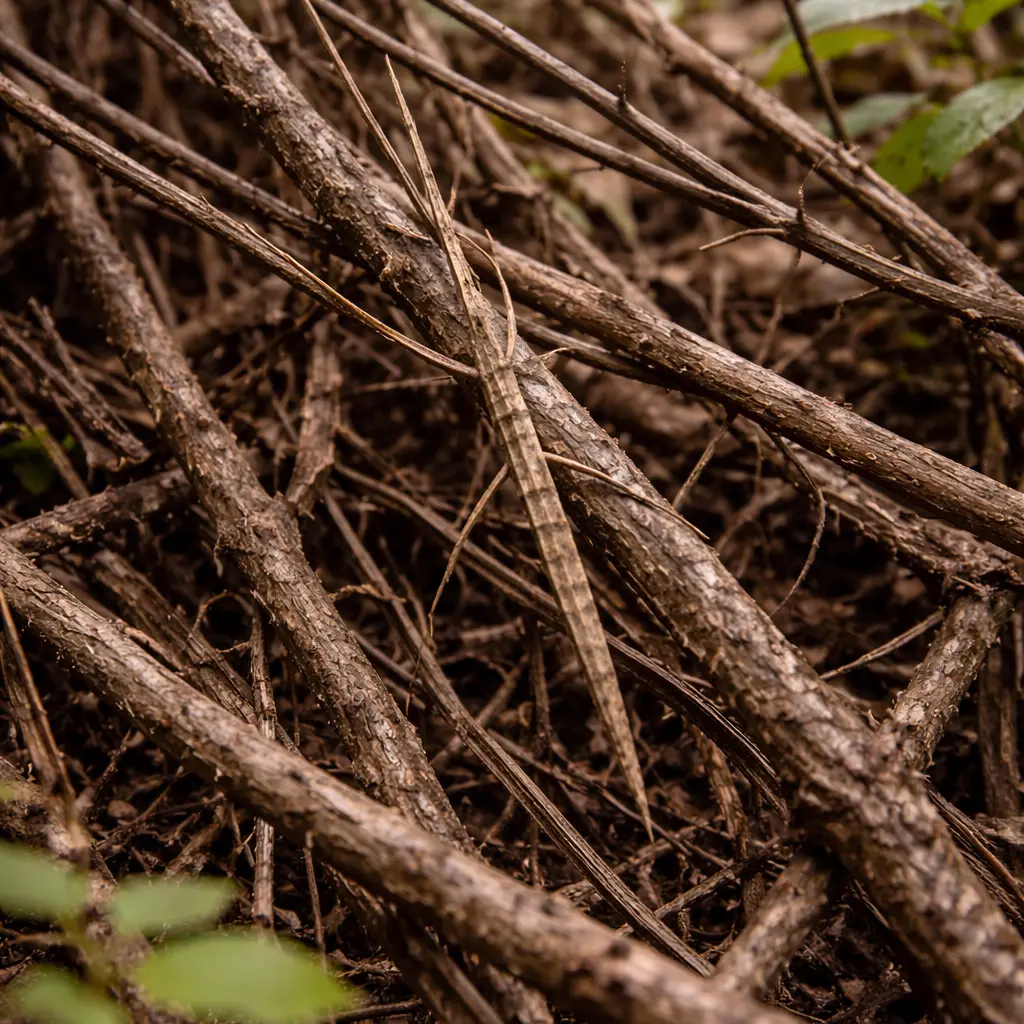
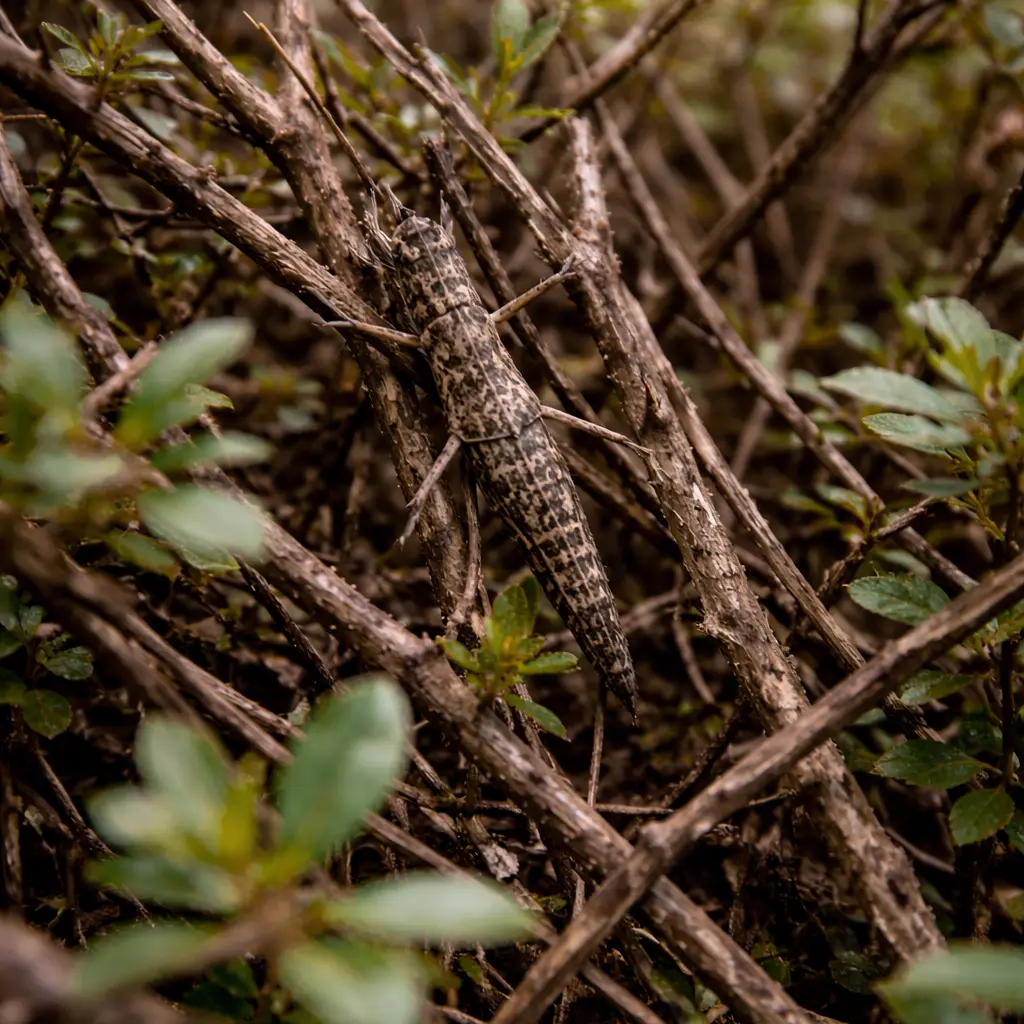
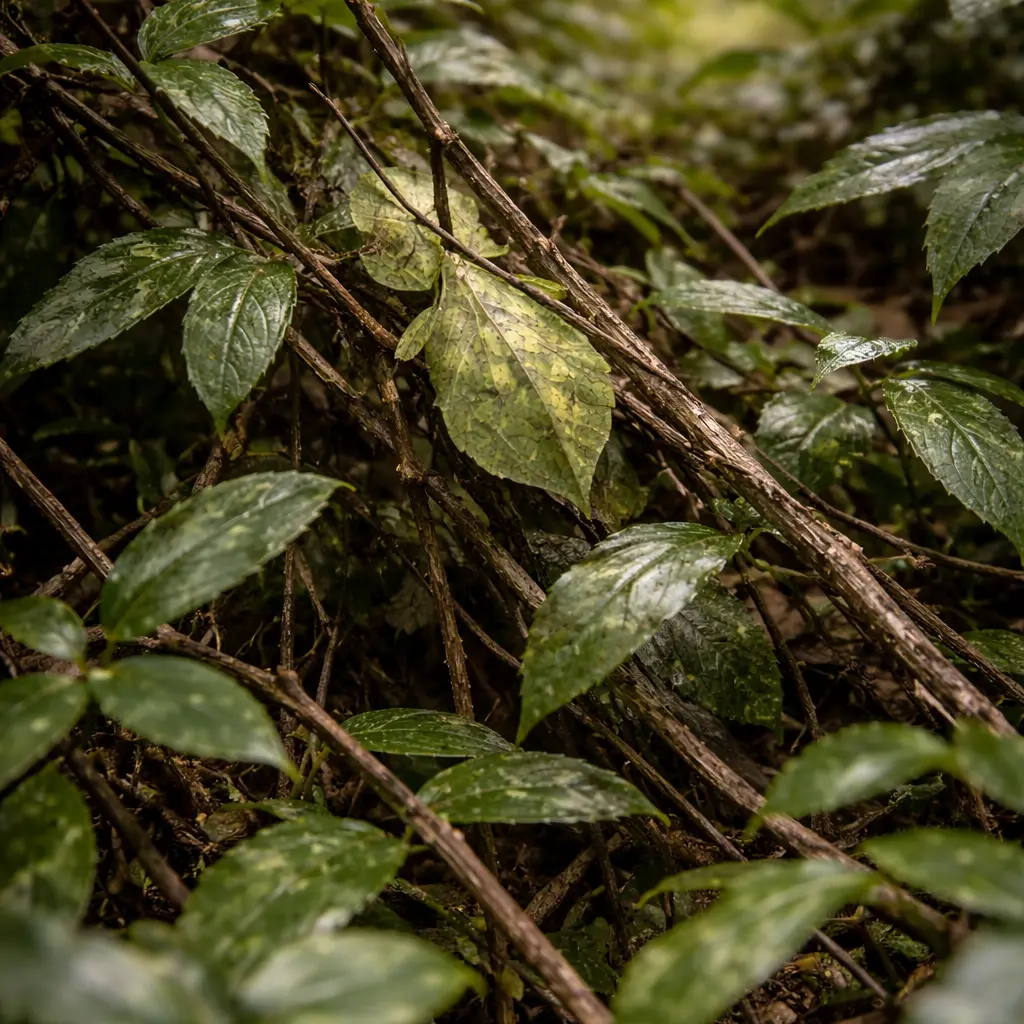


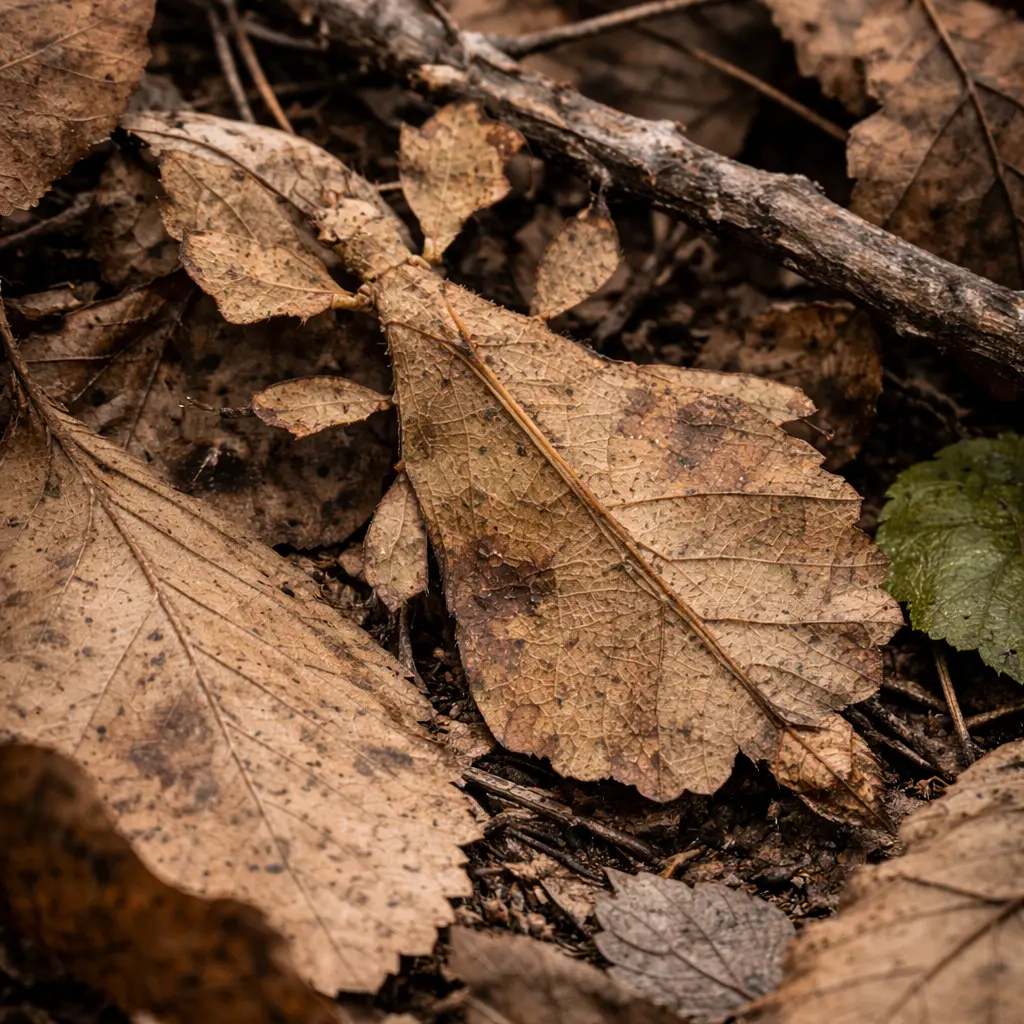
Can you spot the insect? Somewhere in each of these photos, a living creature is staring right at you.
These are phasmids – stick insects and leaf insects – the undisputed masters of hiding in plain sight. The name comes from the Greek phasma, meaning “phantom” or “ghost.” They earned it. With over 3,600 species spread across every continent except Antarctica, phasmids have been perfecting their disappearing act for 165 million years, since the time of the dinosaurs.
This is why our app is called Phasm. The same principle, applied to data: your message doesn’t hide behind walls or locks. It hides by becoming indistinguishable from an ordinary photo. Just like a phasmid on a branch.
Nature’s Steganographers
A phasmid doesn’t run. It doesn’t fight. It doesn’t burrow underground. It hides by becoming its surroundings.
Stick mimicry is the most common form – long, cylindrical bodies with legs positioned to look like branching twigs, complete with bark-like textures, fake thorns, and knots on the exoskeleton. But the real showstoppers are the leaf insects (family Phylliidae). Their flattened bodies have wing venation that exactly replicates leaf veins, and some species go absurdly far: they grow fake brown spots, holes, and chewed edges on their wings to mimic diseased or insect-damaged leaves. They don’t just look like a leaf. They look like a real leaf – imperfections and all.
Other species take different approaches. Some are covered in mossy or lichenous outgrowths – actual 3D textures on their exoskeletons that look like patches of lichen. Many perform a gentle rocking motion, swaying side to side like a twig in the breeze. And nearly all of them are nocturnal: they spend entire days frozen in cataleptic stillness, then move and feed only at night.
Steganography works the same way. A stego image doesn’t encrypt your data behind obvious ciphertext. It embeds your message so subtly that the photo looks identical to the original. Predators (or steganalysis algorithms) look right at it and see nothing.
The Weird and Wonderful
Phasmids aren’t just good at hiding – they’re genuinely bizarre creatures.
They clone themselves. Many species reproduce via parthenogenesis: females produce viable eggs without ever mating. All offspring are female clones of the mother. The Indian Stick Insect (Carausius morosus), one of the world’s most popular pet insects, runs entire colonies of nothing but clones. Some species have completely lost the ability to reproduce sexually. Others engage in what scientists call “cryptic sex” – occasionally mating with rare males to shake up the gene pool.
Their eggs trick ants. Some phasmid eggs look exactly like plant seeds, complete with a fatty appendage that mimics the nutrient-rich coating on real seeds. Ants carry the eggs underground, feed the coating to their larvae, and then dump the “leftover” – the intact egg – in their garbage area. This gives the egg a safe, temperature-controlled incubation chamber protected from parasitic wasps. The phasmids independently evolved the same chemical signaling that flowering plants use to recruit ant seed-dispersers. Convergent evolution at its sneakiest.
They can regrow lost legs – but there’s a catch. Phasmids are the only insect order that regularly regenerates lost limbs. If a predator grabs a leg, they detach it at a weak joint and walk away. Immature stick insects regrow the leg at the next molt. But research has shown that regenerating a leg causes the adult to develop disproportionately smaller wings, significantly reducing flight ability. You get your leg back, but you might lose the sky.
One species sprays peppermint. The Peppermint Stick Insect (Megacrania batesii) from tropical Australia and Papua New Guinea defends itself by spraying a minty-smelling white fluid up to 75 centimeters in any direction. Its cousin, the Two-Striped Walking Stick (Anisomorpha buprestoides) – nicknamed “the Devil’s Riding Horse,” “Witch’s Horse,” and “Musk Mare,” among others – sprays a chemical that can cause temporary blindness in humans and deliberately aims for the eyes.
The Record Holders
The longest insect ever measured is a phasmid. Phryganistria chinensis, discovered in 2014 in Guangxi, China, measures 64 cm (over two feet) with legs outstretched. It was bred at the Insect Museum of West China in Chengdu. The previous record holder, Phobaeticus chani (Chan’s Megastick) from Borneo, held the title for years – and only three specimens have ever been found.
At the other end, Timema cristinae from southern California reaches just 1.16 cm as an adult male. Unlike virtually all other phasmids, it can jump.
Back from Extinction
The most dramatic phasmid story belongs to the Lord Howe Island Stick Insect (Dryococelus australis), known as the “tree lobster” – 20 cm long, 25 grams, roughly the weight of a AA battery. It was declared extinct in 1920 after black rats from a 1918 shipwreck overran its island home and ate every last one.
Or so everyone thought. In 2001, scientists climbed Ball’s Pyramid – a barren volcanic sea stack jutting 551 meters out of the Pacific, 23 km from Lord Howe Island – and found giant insect droppings under a single bush growing in a crevice 100 meters above the sea. They returned at night and discovered 24 survivors clinging to existence on the world’s tallest sea stack.
Two breeding pairs were collected. Melbourne Zoo nearly lost them, then figured out how to breed them. By 2016, they had hatched over 13,000 eggs. Populations now exist at zoos in Melbourne, Bristol, San Diego, Toronto, and Prague. It’s one of the greatest conservation comebacks in history.
Phasmids in Pop Culture
In Pixar’s A Bug’s Life (1998), Slim the walking stick is a circus performer who keeps getting cast as props – a broom, a pole, a stick, a splinter. The joke is that he literally looks like a stick and nobody can tell the difference.
In Disco Elysium (2019), the Insulindian Phasmid – a 3-metre-tall stick insect with extraordinary mimicry – is the game’s central mystery. The entire narrative builds toward discovering a massive creature that has been hiding in plain sight the whole time. Only four confirmed sightings in 50 years. It’s a perfect metaphor for the order.
And in 2022, a pet stick insect named Charlie in Suffolk, England, shed its skin and revealed it was half male, half female – split right down the middle. Left side: bright apple green (female). Right side: brown with long wings (male). The Natural History Museum in London confirmed it as the first reported gynandromorph of its species.
Why “Phasm”
The word phasmid comes from the Greek phasma – phantom, ghost, apparition. These insects earned the name because they are so good at disappearing that encountering one feels like seeing a ghost. They are animals that look like plants. Living phantoms.
Steganography comes from the Greek steganos (concealed) + graphein (writing) – hidden writing. Both disciplines operate on the same principle: the best hiding place is right out in the open.
A phasmid hides among leaves and twigs by becoming indistinguishable from its surroundings. Phasm hides your message inside a photo by making the modifications imperceptible. No encryption prompts. No suspicious files. No trace. Just an ordinary-looking JPEG – with a phantom inside.